Scheduler
Computes the DAG frontier, next-action signals, blockers, and unblocker order before workers run.
Local-first operator system for AI-agent fleets
Harmony lets one engineer safely operate fleets of coding agents: a typed Go control plane gates every change, and a desktop cockpit makes the work visible, reviewable, and steerable.
The Operator Cockpit turns long-running, parallel agent work into one operable surface — DAG frontier, runner lanes, review packets, previews, and ledger evidence in a single canvas — connecting roadmaps and issues to changes you can preview, gate, and audit.
Fleet schedules DAGs of agent work in typed Go, applies policy and trust checks before any write, measures planners against eval baselines, and records every accepted action to a durable audit ledger — improving with every run, proven across 900+ private fleet runs spanning business, product, and development work.
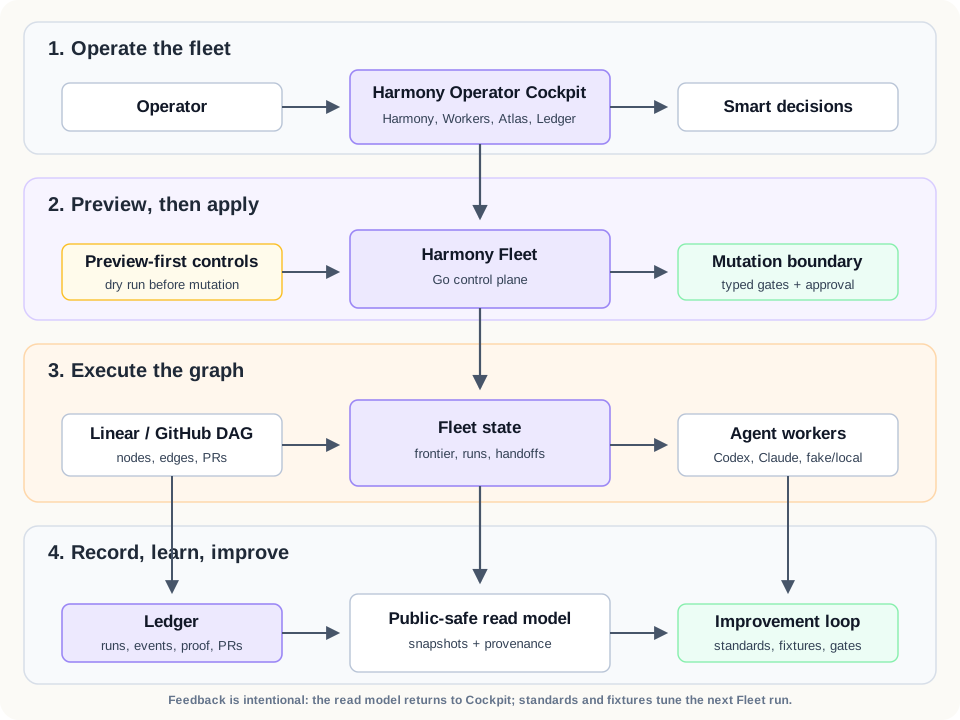
The loop is intentionally operational: plan the graph, let Fleet gate and record worker execution, use Cockpit to focus attention, then turn receipts into better evals, prompts, and release checks.
Fleet turns uncertain worker output into typed decisions, gated previews, durable receipts, and reviewable state.
CLI, daemon, scheduler, policy, evals, runners, and the SQLite proof ledger own the durable state.
Computes the DAG frontier, next-action signals, blockers, and unblocker order before workers run.
Caps, trust checks, schema validation, privacy gates, and stale-preview rejection happen before apply.
Every accepted action becomes durable receipt state for review, replay, evals, and release checks.
A rich canvas for the operator thread, worker lanes, Atlas context, review packets, preview controls, and ledger readback.
The DAG, worker progress, proof requirements, and blockers are visible as the next decision surface.
The operator sees provenance, linked context, evidence, and the exact apply boundary before committing.
Previews are disposable. Applies stay behind Fleet-owned gates and must match current state.
Go owns lifecycle and mutation authority while Codex, Claude, and Python subprocesses plug in through explicit seams.
Long-lived workers handle repository tasks and return progress, outcomes, usage, and proof envelopes.
StructuredGenerator produces pure typed plans for DAG intake without durable mutation authority.
Python tools can join through stdin/stdout contracts while Fleet remains the source of committed state.
The model can propose an action and render the consequences without changing durable state.
Fleet rejects stale previews and unsafe writes before any mutation crosses the apply boundary.
Token, context, cost, cache, and quota pressure are shown as operator telemetry without exposing private metrics.
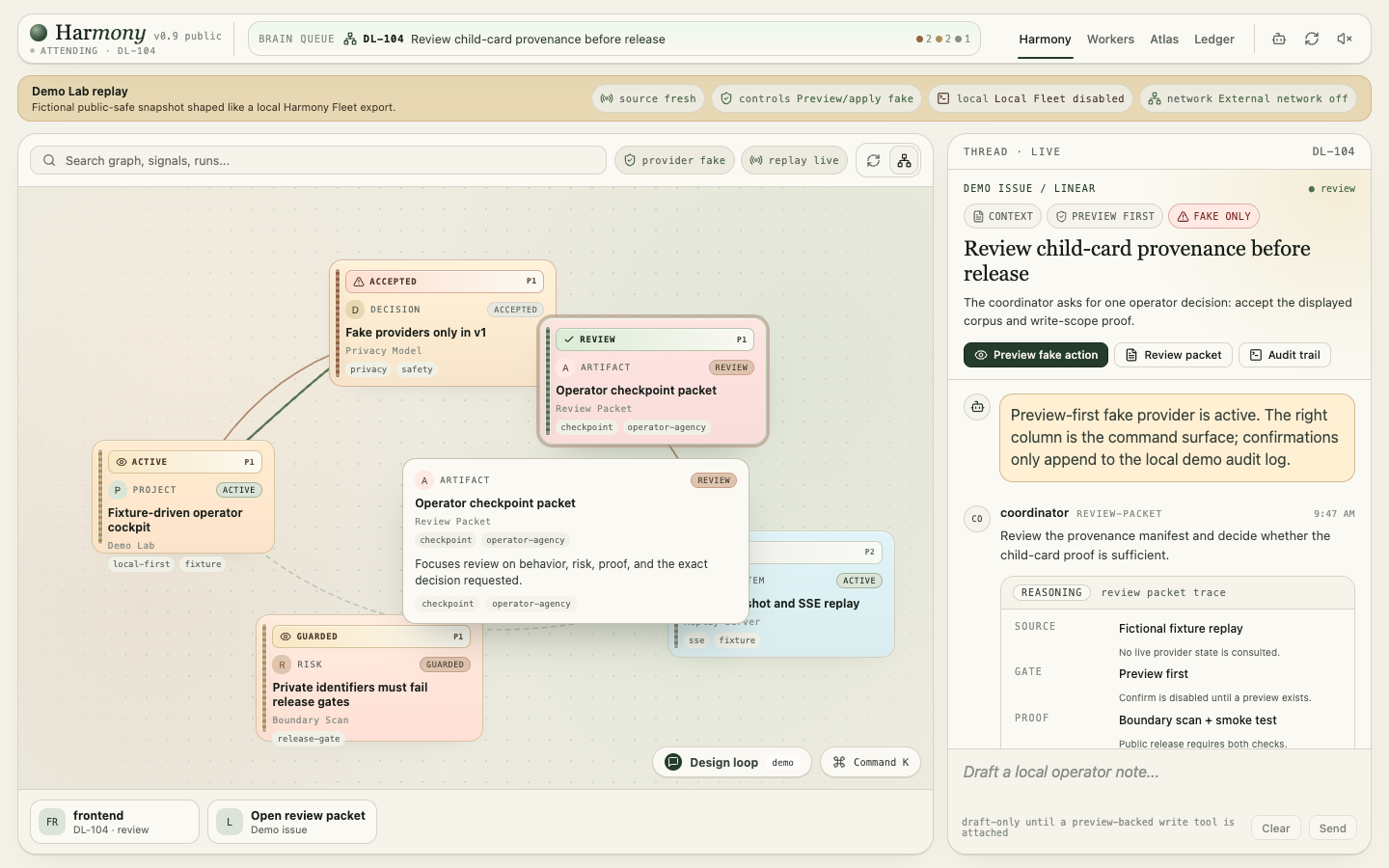
The public GUI tour uses Demo Lab mock fixtures and fake provider adapters, with no external provider mutation or private production state. The important part is the interaction pattern: see the frontier, inspect the evidence, preview the action, then feed the result back into the next run.
Operator Cockpit brings DAG attention, worker lanes, review packets, previews, and ledger evidence into one canvas.
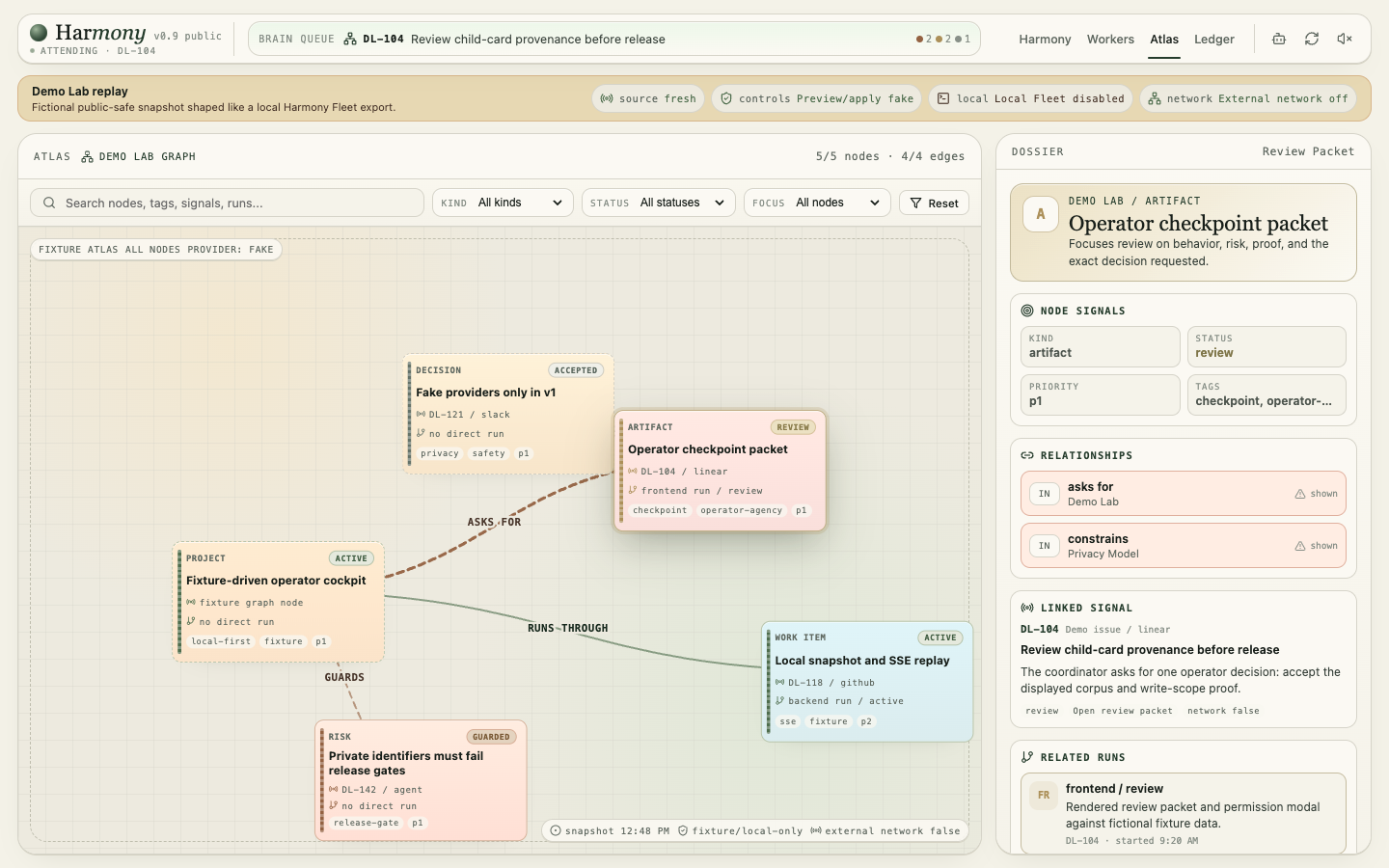
Atlas ties prompts, issues, runs, review evidence, and decisions together so the next unblocker is visible.
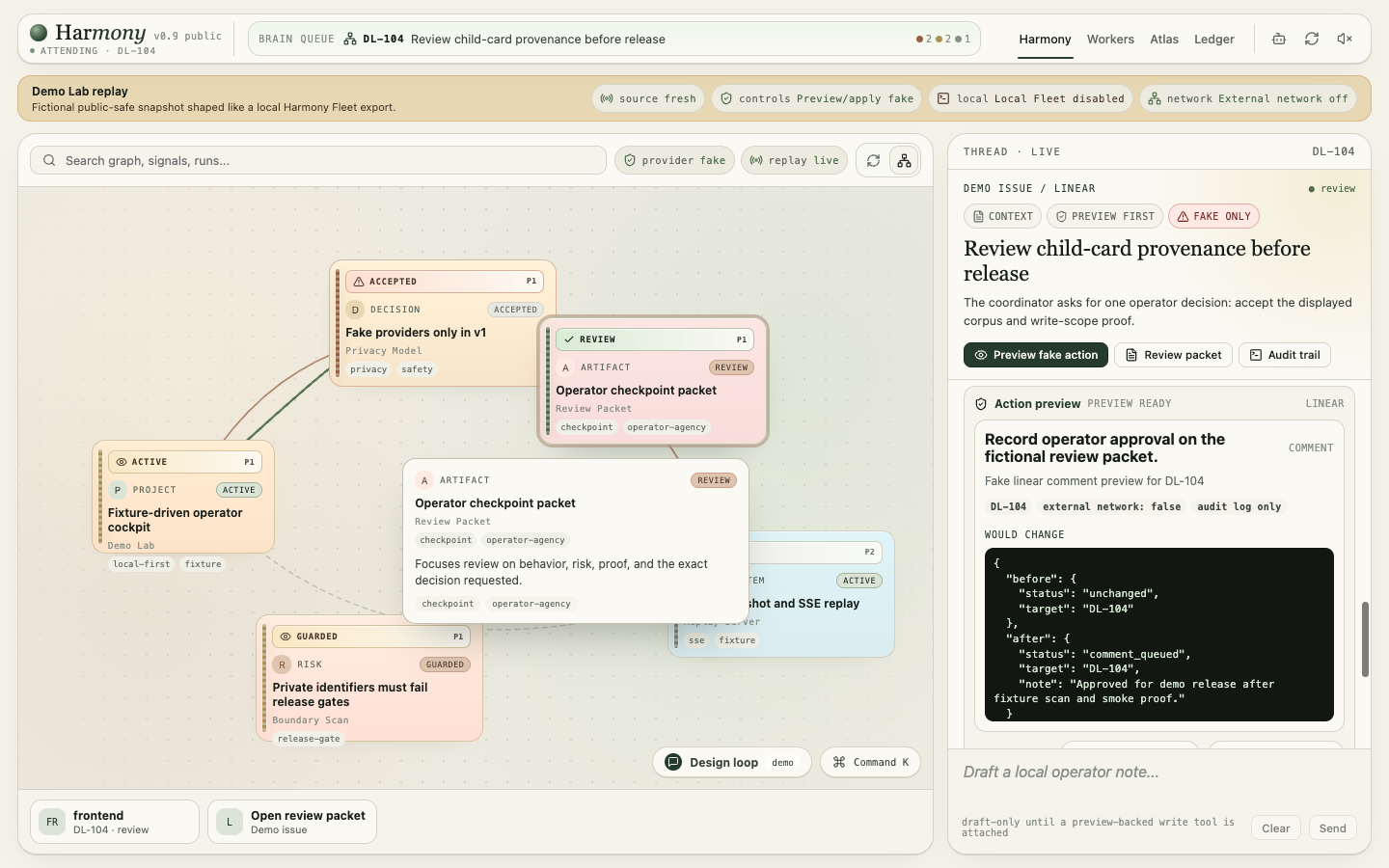
Preview-first control asks Fleet to validate trust, schema, policy, freshness, and current state before any apply path.
The ledger turns runs into durable receipts: proof notes, provenance, token usage, audit events, and follow-up standards.
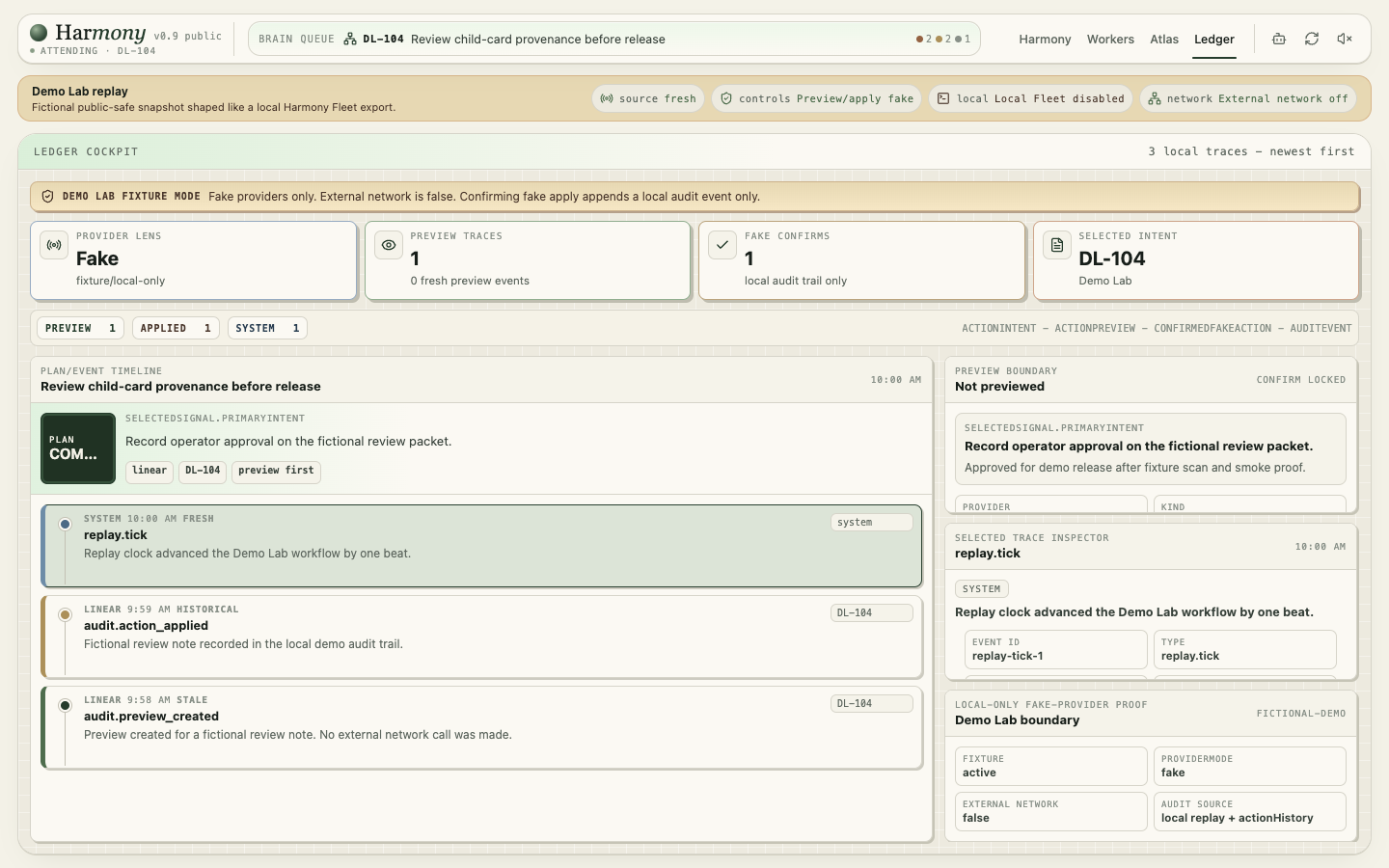
Harmony is public-safe because it separates the real control plane, cockpit, worker contracts, and release gates from private source material that never belongs on a public page.
Harmony Fleet is the Go CLI, daemon, scheduler, policy layer, eval harness, runner system, and SQLite-backed proof ledger. The model proposes; Go commits.
Harmony Operator Cockpit is the Electron surface for DAG attention, worker lanes, Atlas context, review packets, preview controls, and ledger readback.
Preview-first actions keep applies behind Fleet-owned gates. Release and privacy scans prepare operator decisions instead of publishing, tagging, or changing visibility on their own.
The public extraction keeps the reusable architecture, docs, demo material, and proof patterns while leaving private tickets, logs, prompts, databases, credentials, and provider payloads out.
Harmony's proof is not a generic agent claim. It is the concrete engineering loop: typed Go gates, worker protocols, operator attention, usage telemetry, evals, and release discipline.
LLMs draft structured actions, but Fleet owns identity, schema validation, trust checks, DAG safety, SQLite writes, and audited apply boundaries in typed Go.
Runner workers do long-lived workspace work; StructuredGenerator workers make typed intake plans. Python can plug in through stdin/stdout envelopes without owning durable mutations.
Cockpit turns graph status, blockers, worker lanes, review packets, and proof into the single next decision most likely to unblock the work.
Fleet reconciles session and worker-result usage, tracks model/role slices, cache tokens, quota pressure, and cost-per-output signals for operating the fleet.
Planner evalsets, worker calibration, proof failures, and ledger readback become concrete changes to prompts, standards, gates, fixtures, and future run habits.
The receipts are commands and component checks. They prove release posture, privacy posture, worker boundaries, and preview-first controls without claiming market outcomes, live provider authority, or benchmark superiority.
make proofRuns the full local lane: layout, privacy, whitespace, Fleet CI, Cockpit install/typecheck/tests/build/smoke/e2e, media readback, cleanup, and final scans.
make release-scanRuns the faster publication-boundary scan for privacy and release drift before any visibility or launch-copy decision.
Checks planner behavior, runner contracts, policy gates, preview/apply validation, and the safety boundary around DAG mutations.
Checks the operator surface, source contract, release scan, review packet rendering, ledger states, and preview-first UI behavior.
Review the public tour, then read the source: Fleet (the Go control plane) and the Operator Cockpit (Electron) ship together in one repo, Apache-2.0.
Apache-2.0. Demo Lab data is fictional; the interaction patterns come from real private fleet runs.